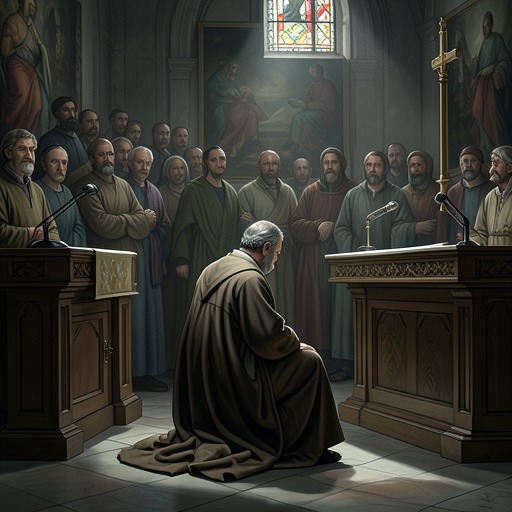
God—humanity relationship
The Parallax ViewThe book treats the God—humanity relationship not as a settled bond between an all-powerful ruler and dependent subjects, but as a conflict over freedom, responsibility, law, and suffering. Its decisive turn is from explanations that preserve divine mastery toward the figure of a suffering God: one involved in history and affected by human misery, rather than a remote authority who secretly guarantees that events serve a higher plan.
Sovereignty, evil, and human freedom
The problem begins with the Holocaust, which the book describes as a trauma that breaks the apparent link between truth and meaning. The existence of immense suffering among the innocent confronts theology with a question its usual accounts cannot comfortably contain: how can a God who is both good and omnipotent have permitted it? The book organizes proposed answers into successive triads, treating them not as interchangeable consolations but as attempts to preserve or revise the terms of the relationship between divine power and human responsibility.
The first set keeps divine sovereignty intact. A legalistic account interprets catastrophe as punishment for humanity’s or the victims’ past sins. A moralistic account treats suffering as a test through which faith or character might be strengthened. A third appeals to divine mystery when ordinary measures of explanation fail. But the last move unsettles the first: if the mystery must be beyond human understanding, it cannot simply be assumed to reconcile catastrophe with a fully sovereign God. The book’s Hegelian turn is that the mystery God presents to humanity must also involve a division or limit within God, rather than serving as a final explanation that restores unqualified omnipotence.
A second set of answers makes that limit explicit. God may be finite or overwhelmed by the inertia of creation; God may have freely restricted divine power to make room for human freedom, leaving human beings responsible for evil; or divine power may face an independent counterforce identified with evil. Each option alters the allocation of responsibility, but none by itself resolves the origin of evil. The relation remains strained between a God who is responsible for what happens, a God who yields power, and a world in which evil cannot be reduced to either human choice or a single divine intention.
The suffering God and history
The book’s alternative is neither a triumphant God who secretly controls every outcome nor a perfectly just ruler whose decisions are beyond question. It is a God who suffers in solidarity with human beings, in the manner of Christ on the Cross. Drawing on Friedrich Wilhelm Joseph Schelling, the author emphasizes that God is a life subject to fate, suffering, and becoming, not merely an unchanging being. Divine suffering therefore means that history is not just a stage on which a transcendent master directs appearances: it is a field of real struggle in which the Absolute itself is involved and its fate is at stake.
This interpretation gives particular force to Dietrich Bonhoeffer’s post-Holocaust theological insight: only a suffering God can help humanity now. The victims’ suffering is not treated as evidence that a hidden design must eventually make everything right. Instead, its excess over any ordinary human measure marks the point at which a religious language of catastrophe becomes necessary to approach what secular explanation can leave diminished. The book invokes the question of why the heavens did not darken to convey the inadequacy of treating such suffering as merely one more human misfortune. Theology is challenged by catastrophe, yet, in the author’s argument, its language can also register the scale of the challenge.
That claim does not promise that the past will be redeemed by being absorbed into a higher meaning. Recalling Walter Benjamin’s account of a weak messianic power and the secret bond between past and present generations, the book asks whether redemption can be asserted without making the victims’ suffering retrospectively worthwhile. Its answer turns on the failure of any final reconciliation that would cancel the raw fact of suffering. The relation between humanity and God passes instead through a stage of absolute humiliation, in which human beings are reduced to objects of divine contingency before freedom can be fully asserted. This is not a comfortable resolution: it names a break in the exchange between master and subject rather than a simple restoration of trust.
Christianity’s changing forms of mediation
The book also describes Orthodoxy, Catholicism, and Protestantism as successive configurations of the relation between divine authority, sacred text, institution, and believer. In Eastern Orthodoxy, the text and the community of believers remain substantially united: the community interprets the sacred text, which continues to live within religious history. The community is not merely an audience receiving a standard from outside itself.
Catholicism establishes a sharper separation. The Church becomes an autonomous mediator with authority to interpret the text. The book underscores that distance through the Mass in Latin, which ordinary believers do not understand, and through the restriction against reading the text without priestly guidance. The institution stands between the believer and the divine word, so the relationship is organized through ecclesiastical authority rather than direct access.
Protestantism removes that particular mediator and places the text itself at the center, wagering on each believer’s direct contact with the Word of God. The individual thereby occupies what the book calls a universal-singular position: a singular person related directly to divine universality, without the Church as necessary intermediary. Yet this apparent immediacy does not make God familiar or negotiable. Protestantism begins, in the author’s account, with God as an impenetrable Beyond, whose grace is distributed contingently and without a common measure shared with humanity. The mediator recedes, but divine authority does not become more predictable.
The book finds an audible expression of that anxiety in Johnny Cash’s final recorded song, The Man Comes Around, which it reads as an articulation of Southern Baptist Christianity’s exposure to an unconditional divine judgment. The example connects religious form to lived expectation: a direct relation to God can mean not reassurance but vulnerability before a power that does not answer to human standards of fairness.
Incarnation, grace, and human abjection
The account of the Incarnation further distinguishes three ways of construing God’s relation to humanity. In Orthodoxy, the elevation of Christ into an exemplary ideal risks making him a model for human imitation. In Catholicism, the relation is cast as symbolic exchange: Christ pays for human sins, and redemption takes the form of a juridical transaction. The book associates Martin Luther’s protest with the danger that such an exchange could make salvation seem purchasable through the Church.
Luther’s account begins from a different kind of impasse. The more he performed good deeds, repented, and punished himself, the more guilty he felt; good action became another occasion for suspicion rather than a route to divine favor. In the book’s interpretation, this pressure helps explain why salvation must come through faith in Christ rather than through a calculation of meritorious deeds. The Protestant understanding of the Incarnation then makes the relationship real in a distinctive sense: Christ freely identifies with humanity in its abject condition. Divine love is not love for an idealized human being who has risen toward God, but love directed toward humanity at its most radically diminished.
This account makes the Incarnation more than a lesson in imitation or a payment that settles a debt. It presents God as assuming the condition from which human beings cannot make themselves worthy of divine recognition. Grace consequently does not reward a successful effort to escape human finitude; it interrupts the cycle in which effort, guilt, and renewed effort reinforce one another.
Law, prohibition, and the displaced conflict
The relation is also structured by law and freedom. In its discussion of the Fall, the book argues that the prohibition addressed to Adam and Eve carries a divided demand: humanity is given freedom while being expected not to use it to become free of the Creator. The only guiltless use of this gift would be to refrain from using it, a forced choice in which the permission and its limit are inseparable. The book suggests that the prohibition on eating from the Tree of Knowledge may itself contain a covert injunction to transgress, making God internally inconsistent rather than a source of perfectly transparent commands.
This division resurfaces in the account of Christ’s death. Christ lays down his life of his own accord, yet humanity remains implicated in the desire for his death. Caiaphas justifies delivering one person to death as expedient for the people; the book asks whether Christ’s voluntary sacrifice repeats the logic of scapegoating the innocent, even as it is presented as a gift to humanity. The question complicates any account of redemption that treats consent as sufficient to remove the responsibility of those who benefit from the sacrifice.
The book’s discussion of Jewish tradition extends the conflict between law and a promised release from constraint into its critique of antisemitism. It describes how a Christian fantasy of overcoming law and attaining unrestricted enjoyment can cast Jews as the obstacle to that imagined freedom. This is not presented as a truth about Jews, but as an anti-Semitic construction that turns a group into the symbolic cause of a limit that cannot in fact be abolished. The book connects that construction to a broader displacement: social antagonism, especially class conflict, is projected onto an imagined external intruder, allowing society to appear harmonious once the supposed obstruction is removed. The underlying argument is that the law marks human finitude, while fantasies of escaping it can convert that limit into a target.
Divine self-generation and its limit
The book’s analysis of capital offers a contrasting image of self-generation that sharpens its account of theological relations. Drawing on Karl Marx, it describes capital as value that moves through money and commodities, generates surplus value, and retroactively posits its own conditions. Marx’s image of a father and son who differentiate themselves and then become one again gives the movement the form of a self-producing relation. The book compares that circular structure to the Christian identity of God the Father and the Son, but does not treat the analogy as proof that capital is truly divine.
Instead, capital’s apparent self-sufficiency is exposed as a fantasy that depends on the proletariat’s labor. Its movement may present itself as automatic and self-generating, but it has a limit and produces conditions for its own collapse. The contrast returns to the book’s broader account of God and humanity: a relation represented as complete self-sufficiency can conceal the dependence and antagonism it cannot acknowledge. Across theology, law, and political economy, the book repeatedly locates the possibility of change not in a perfectly closed order, but in the internal limit that prevents such an order from being whole.